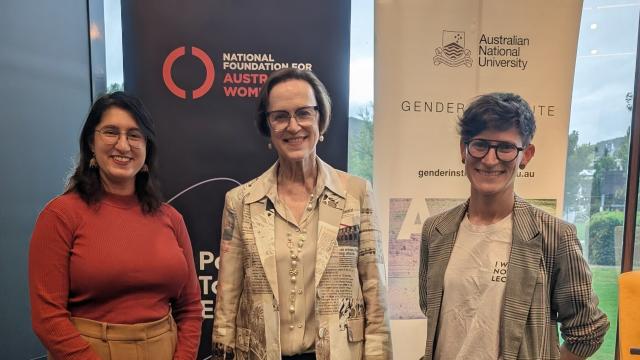
Event Summary by Emerita Professor Margaret Jolly
A huge thanks to the organisers and speakers this evening – Sally Moyle, Asha Clementi, Caroline Millar, and Elise Stephenson. This has been a consummate collaboration between the National Foundation for Australian Women and the ANU Gender Institute. Thanks to those of you in the audience for great questions.
This evening’s panel is exceptionally timely. With an incendiary geopolitics igniting into war in the Middle East engulfing Iran, Lebanon, the Gulf States while violent conflict continues despite “ceasefires” in Gaza and into the West Bank, civil war still rages in Sudan and Russia’s invasion of Ukraine intensifies, a path to peace is urgently needed. We have heard about how the Women, Peace and Security agenda offers a potential pathway in navigating these turbulent times. We have heard about how there is a pervasive pushback not just against the WPS agenda but against gender equality, generally and globally. This is a well-financed campaign not just in the fraught spaces of international diplomacy and negotiation (like the most recent Commission on the Status of Women) but in the funding of right wing, populist politics in many nations, including our own with the surging polls for One Nation. And we have a new National Party leader imagining a ‘hyper’ Australia of macho values, ubiquitous BBQs and more children (presumably preferably white). We have heard from Elise how patriarchal principles pervade not just our fragile planet but the realms of outer space, with the colonizing dreams of billionaire tech bros like Elon Musk. This is vastly different to how Samantha Harvey in her novel Orbital (2023) evoked the wonder of looking back at earth, uniting the astronauts in the International Space Station across geopolitical divides.
I offer a final thought about how the violence of war and militarism in geopolitics is connected to the intimate body politics of gender. This link is patent in countries like Iran where the despotic regime and the martial control of the Islamic Revolutionary Guards is intimately linked to keeping women in their place, policing how women dress, even down to the details of how they wear their hijab. This was palpable in the resistance of Iranian women and men to the murder of Mahsa Amini in 2022. And, alongside economic precarity, gender inequality is a major catalyst for resistance to the regime which, after the murder of tens thousands of Iranian citizens, is still being violently supressed as the bombs are dropping.
But that close connection across the scales of the body politic is also clear in other countries, and especially in Trump’s America. Here the overseas military interventions, punctuated with masquerades of ‘peace’ and diplomatic ‘deals’, are accompanied by wars within: attacks on allegedly undocumented migrants and resistant citizens and a full frontal attack on gender equality. Transgender people are on the frontline of this violent assault but this is a full blown war on gender equality and indeed gender itself. An ugly reanimated biological determinism is claiming gender does not exist. There is only sex. Attempting to erase decades of feminist debates about sex/gender and nature/culture distinctions. Epistemic violence conjoined with violent actions and policies. Women’s reproductive rights have been rolled back, diversity, equity and inclusion in the workplace is eroded. Gender is a forbidden word in the US, unable to be used in urgent programs of public health, in research and scholarship and in any projects using US government funds, domestically or what is left overseas with the dismantling of USAID in 2025.
The WPS agenda recognised rape as a weapon of war and as Elise has stressed ‘security’ involves the human intimacies of gendered body politics as much as the imagined bodies and borders of nation states.
It is crucial to connect these two fronts of war, wars without and wars within, and to try to use whatever peaceful processes and strategies we have, like those charted by the WPS agenda, to navigate and survive these turbulent times. May tonight’s excellent discussion be a catalyst for all of us in that process.
First published by the National Foundation for Australian Women, see post here
File attachments
| Attachment | Size |
|---|---|
| PDL-2026_event-summary-by-Prof-Jolly.pdf | 545.74 KB |