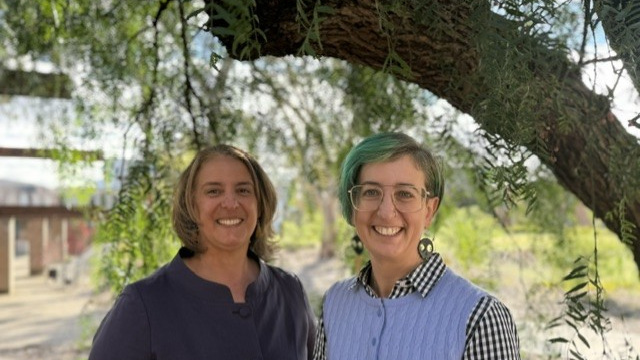
Photo: Kathryn Vukovljak/ANU
We are delighted to announce that the Gender Institute has two new Co-Directors, Associate Professor Caroline Schuster and Associate Professor Sonia Palmieri. Both have longstanding engagement with the work of the Institute and bring exceptional experience to their leadership roles. We are excited to be entering this new phase and hope you will join us in enthusiastically welcoming our new leadership team.
Em. Prof. Fiona Jenkins (on behalf of the Gender Institute Management Committee)
ASSOCIATE Professor Caroline Schuster and Associate Professor Sonia Palmieri have been appointed as the ANU Gender Institute’s first co-directors, taking up the interim roles as the Institute is moved into the Research and Innovation Portfolio.
The Institute supports gender and sexuality research, education and advocacy across ANU. Founded in 2011, it connects researchers, students and staff working on gender equality from every College, and runs a program of grants, prizes, mentoring and public engagement to build that research profile on campus and beyond.
Schuster says she's keen to be involved in building the Institute's research profile within ANU, nationally and internationally, and supporting excellent gender research from the bottom up.
“As a feminist economic anthropologist, gender and economic inequality run through my teaching, from a cross-cultural perspective – that's one of my key investments in training the next generation of engaged feminist and gender scholars," she says.
"I'm very committed to maintaining that role, and I see it as entirely compatible with being co-director of the Institute.”
The co-directorship is a new model for the Institute, and the first time in its 15-year history that the Institute has been led jointly and from a central Portfolio.
“The model is aligned with feminist approaches to leadership that value inclusivity and shared responsibility,” says Palmieri, who also points to the Institute’s role modelling among peer gender institutes internationally.
The co-director appointments bring together two areas of focus. One is institution-facing, centred on making ANU a safer, more respectful place for women and gender-diverse students and staff – work that has taken on added significance following the Nixon Review.
The other is research-facing, focused on strengthening the Institute’s grants framework, building cross-campus collaboration, and extending the reach of gender and sexuality research into policy.
Schuster is an Associate Professor in the CASS School of Archaeology and Anthropology, where she works as an anthropologist researching microcredit, insurance and climate risk in Latin America. Palmieri is an Associate Professor in CAP’s Coral Bell School of Asia Pacific Affairs, researching women's political leadership and gender-sensitive parliaments, including in the Pacific.
While the Institute has sat within several Colleges since its inception, Schuster and Palmieri say the move to the R&I Portfolio aligns it with the other institutes at the University.
“We’re excited that to be working with the Research Infrastructure and Entities (RIE) team, in part because it recognises the genuinely cross-campus profile of the Institute,” says Schuster.
The ANU Gender Institute has a strong record of incubating research that goes on to secure funding from bodies such as the Australian Research Council (ARC) and government departments, with past support spanning disciplines as varied as public health, law and the humanities.
There’s already a full agenda underway, starting with the Institute’s annual research prizes. The prizes have run since the Institute was founded and recognise gender and sexuality research at different career stages. This year’s prizes will be awarded on 20 August.
The prizes draw entries from across the University, with previous winners having gone on to build sustained careers in gender and sexuality research. Some return years later as Article Prize winners after first being recognised at Honours or Masters level.
Schuster and Palmieri are also reviewing how the Institute is governed, with a new management committee model and advisory group under consideration. They’re also working towards what they describe as a research-to-policy pipeline.
“We want to ensure our excellent researchers can create impact by supporting the long tail of their research,” they say.
The Institute’s network has grown to more than 320 active members across campus, with its newsletter reaching thousands more.
“We welcome all researchers from across campus who embrace this wider suite of justice-oriented, inclusive and intersectional methods and priorities, including HDR students,” says Schuster.
Words by Kathryn Vukovljak - article first published in Research & Innovation July News